
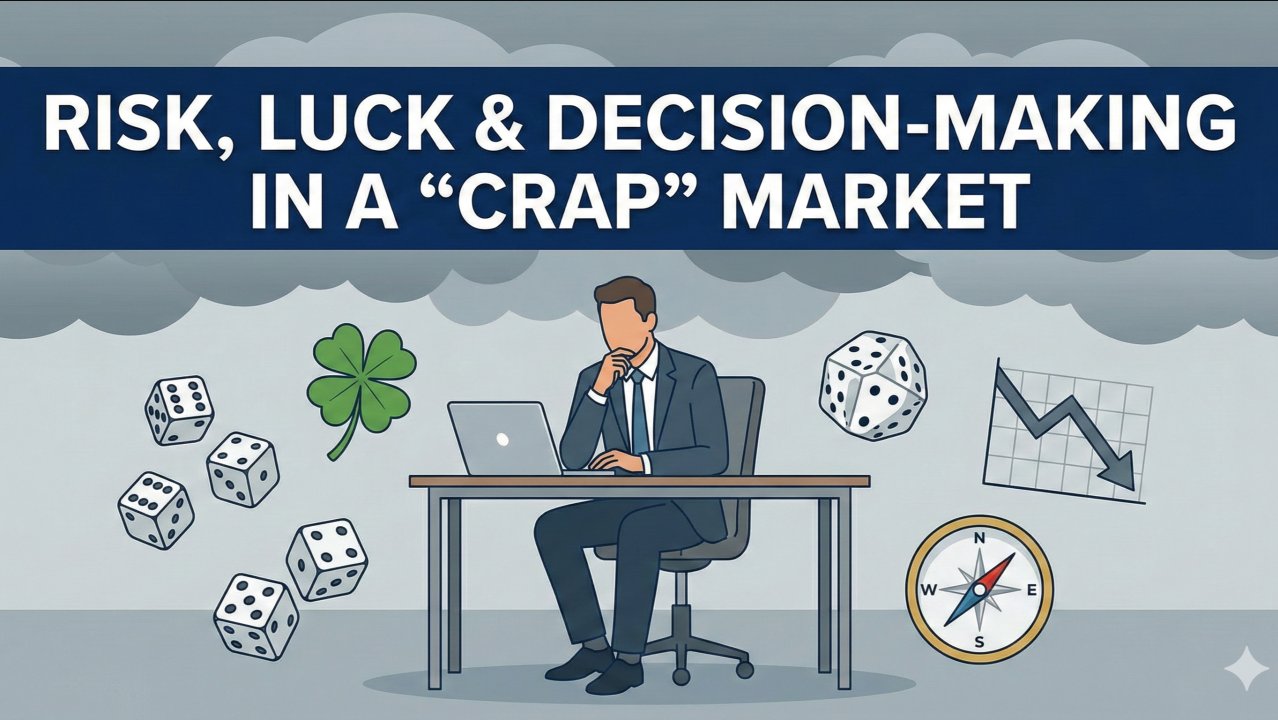
“Survive ’til ’25” is what the experts said. In 2024 we saw interest rates spike and buyer demand evaporate. The resounding advice, reassurance even, was that 2025 would be better. Much better. Buyer demand would rebound, insurance prices would improve and mortgage rates would drop. Or, even if they didn’t, buyers would get used to the new normal and start house hunting again.
I’ll admit I bought into the hype. We set big goals for our brokerage, thinking the pendulum would swing back and transaction volume would return with a vengeance. And yet here we are closing out 2025 in an eerily similar setting.
I know countless investors who lost money over the past two years, and there are far fewer people in real estate now than three years ago. Not just investors. We’ve lost agents, lenders and brokers too. If you lost money on a deal in 2024 or 2025, you’re not alone. Lots of us did. I personally had two or three flips that flopped, so we refinanced and rented them out until the market improves.
But we’re still standing. And every day in a bad market is one day closer to a good market. Here are a few mental models I’m taking into 2026, virtually all stolen from others, with credit where it’s due.
Think in probabilities, not certainties
Dave Meyer, VP of data and analytics at BiggerPockets, gave a keynote at BPCON a few years ago that completely changed how I think. His point: successful investors don’t think in certainties, they think in probabilities. The goal isn’t to be right 100% of the time. It’s to make decisions that are more likely to lead to good outcomes over the long run.
When we ask what the market will do next year, there is no certainty, and anyone who gives a certain answer doesn’t know what they’re talking about. People hear “there’s an 80% chance of a recession” and assume it will happen. But the most probable scenario isn’t guaranteed. A football team with an 80% chance of winning still loses two times out of 10.
Think of the scene in Avengers: Infinity War where Doctor Strange looks at 14,000,605 possible futures and finds that the heroes win in just one. The most probable outcome isn’t guaranteed to happen.
Say you’re flipping a house. You run the numbers and estimate a 75% chance of making money, a 20% chance of breaking even and a 5% chance of losing money. Great odds, but there’s still risk. Thinking in probabilities takes off the blinders and shows you the other possible outcomes so you can plan for them.
Look for asymmetric bets
Thinking in probabilities also helps you find what Brandon Turner calls asymmetric bets: calculated risks where the upside is far bigger than the downside. All investing involves risk, but it doesn’t have to be a coin flip. You want the odds in your favor, and you want the reward to be much bigger than what you’d lose if things go wrong.
Back to the flip with 75/20/5 odds. If I have a plan B to refinance and rent out the property with decent cash flow, my risk is low even if the 5% happens. Compare that to a 75% chance of making $40,000 if things go right. That’s an asymmetric bet.
Hiring is another example. If I pay someone $12 an hour to take low-level tasks off my plate and it doesn’t work out after 30 days, I’ve lost a few thousand dollars. If it does work out, the upside in leverage, revenue and growth could be worth hundreds of thousands.
Luck and risk are two sides of the same coin
If you want outsized returns, risk is always involved. You can, and should, look for ways to reduce risk, but you can’t get it to zero and still expect to make money. Morgan Housel puts it well in The Psychology of Money: luck and risk are siblings. Both are the reality that outcomes are shaped by forces beyond our own effort.
We like to credit our own good fortune to hard work, while someone else’s is “just luck.” When things go wrong for us, we were unlucky, but when the same thing happens to someone else, they made a bad decision. Funny how that works.
You can make an excellent investing decision with sound fundamentals and a high probability of success and still lose. Improbable outcomes happen all the time. There’s a saying that a one-in-a-million chance happens eight times a day in New York City. That doesn’t mean you should throw out your checklist and rely on luck, but you should accept that luck exists and will affect your investing career.
Increase your surface area for luck
Risk and luck are unavoidable, but we shouldn’t just wait for luck to strike. Lightning is a good example. In a thunderstorm, if you go inside and I take a boat to the middle of a lake holding a giant metal rod in the air, who’s more likely to get “lucky”? I can’t control which of us gets struck, but the odds aren’t exactly in my favor.
Investing works the same way. Stumbling onto a grand-slam off-market deal might be lucky, but networking, door knocking and advertising all increase your surface area for luck.
I bought many of my rentals between 2016 and 2020. After COVID, I got “lucky” and refinanced all of them at rates under 3%. That was completely out of my control. But by buying in the years before 2020, I gave myself far more surface area for luck than someone who never took a chance. Things could just as easily have gone the other way, which is the point: risk and luck travel together.
If you want lightning to strike, be like Benjamin Franklin and go fly a kite. Work hard, network and put yourself out there. You’ll be surprised how much luck you can generate.
Always be on upset alert
I love college football, undeniably the greatest sport on the planet. On any given Saturday, anything can happen. In 2022, Appalachian State went to Kyle Field as a 19-point underdog against Texas A&M and won 17–14.
My favorite college football analyst, Josh Pate, has a segment where he breaks down how a big underdog could pull off an upset. He admits it’s unlikely, but asks a powerful question: if the underdog were to win, what would need to happen?
It sounds unrelated to real estate, but it’s a great habit. If the unlikely bad outcome were to happen, what would cause it? On our flip, maybe the comps were wrong and the after-repair value is off. Maybe you skipped the inspection and there’s $13,000 of sewer work (been there). Maybe your contractor robs you blind. Maybe the renovation runs six months long and holding costs eat your profit (been there too). Maybe rates double in three months and buyers scatter like roaches.
Some of those are in your control and some aren’t. Thinking through what could go wrong tells you what to watch for. Don’t underestimate your opponent.
Don’t judge decisions only by their outcome
Many people fall into the trap of “bad outcome equals bad decision.” Good decisions made with sound judgment sometimes turn out badly, and bad decisions sometimes turn out well.
You can research a low-cost index fund, invest $1,000 and watch it drop 25% the next month. Meanwhile, I go to the casino, put $1,000 on red and win. The outcomes don’t change the fact that your decision was objectively good and mine was objectively bad. Judge each decision by its quality, given the information you had at the time.
We should still use outcomes to sharpen our process. Say I lose $20,000 on that flip because the market dropped 10% during the renovation. If my analysis was solid, it was still a good decision. But I should probably underwrite future deals for a 10% to 15% drop, or only buy flips that also work as rentals. A decision can be good, have a bad outcome and still teach you something.
The biggest mistake: quitting
The biggest mistake I see is quitting after the first try. Someone flips a house, buys a rental or wholesales a deal, and it doesn’t go to plan. They work hard just to break even, or lose money, and decide “this isn’t for me.”
Why quit now? You’ve already paid for the lessons with your time and maybe your money. Nobody is good at anything on the first swing, so why would real estate be different? Look honestly at what went wrong. Was it a bad decision? Was your math off? Or was it a good deal that hit the small chance of a bad outcome?
Either way, the only way to lock in your losses is to quit. Real estate is a long game, and if you play it right, with solid fundamentals and without over-leveraging, it’s surprisingly hard to lose over the long term. Time heals a lot of wounds, and even a bad deal can become a decent one with years of appreciation and rent growth. You probably won’t get rich overnight, but the version of you 30 years from now will be glad you stuck with it.
The short version
- Think in probabilities, not certainties.
- Look for asymmetric bets.
- Luck and risk are two sides of the same coin.
- You can increase your surface area for luck.
- Don’t judge decisions solely by their outcomes.
Want to talk through a deal or your plans in St. Bernard Parish? Call Arpent Realty at 504-356-3897, or see how we work with real estate investors.
Common questions
What is an asymmetric bet in real estate?
A deal where the possible upside is much bigger than the possible downside, like a flip with a strong chance of profit and a solid backup plan to rent the property if the sale doesn’t work out.
Should I quit real estate investing after losing money on a deal?
Not necessarily. Figure out whether the decision was bad or a good decision hit an unlikely bad outcome, adjust your underwriting, and keep going. Quitting is the only way to lock in the loss.
This post is for general information and is not investment advice.
This post first appeared on LinkedIn on December 4, 2025.