Key takeaways
- St. Bernard Parish has two new federal Opportunity Zones under Opportunity Zones 2.0, effective January 1, 2027, for 10 years.
- The zones are Census Tract 306.01 (Arabi / West Chalmette) and Census Tract 302.04 (eastern Chalmette, Meraux and the riverfront near Violet). Both are non-rural.
- Investors who put capital gains into a Qualified Opportunity Fund can defer that tax for five years, pay tax on only 90% of it, and pay no federal tax on new appreciation after a 10-year hold.
- The zones line up with the planned Louisiana International Terminal in Violet and the need for new and renovated housing across the parish.
What happened
In November 2026, the U.S. Treasury certified 6,576 census tracts nationwide as new Opportunity Zones, effective January 1, 2027. Louisiana received 156 of them, nominated through a regional selection process run by Louisiana Economic Development (LED). Two of those tracts are in St. Bernard Parish. The designations last 10 years.
This is the second round of the program. The first round, created by the 2017 Tax Cuts and Jobs Act, gave Louisiana 150 zones in 2018, including three in St. Bernard. The One Big Beautiful Bill Act, signed July 4, 2025, made Opportunity Zones permanent and set up a new map every 10 years. That’s why the zones changed.
What is an Opportunity Zone?
An Opportunity Zone is a lower-income census tract where the federal government gives investors a tax break for putting money to work. The break isn’t for living or owning property there. It’s for investing capital gains (profit from selling stock, a business, real estate or other assets) into a Qualified Opportunity Fund (QOF). The QOF then buys, builds or improves property, or funds a business, inside the zone.
A QOF is usually an LLC or partnership that holds at least 90% of its assets in qualifying zone property. Investors can join an existing fund or set up their own.
Where are St. Bernard Parish’s two new Opportunity Zones?
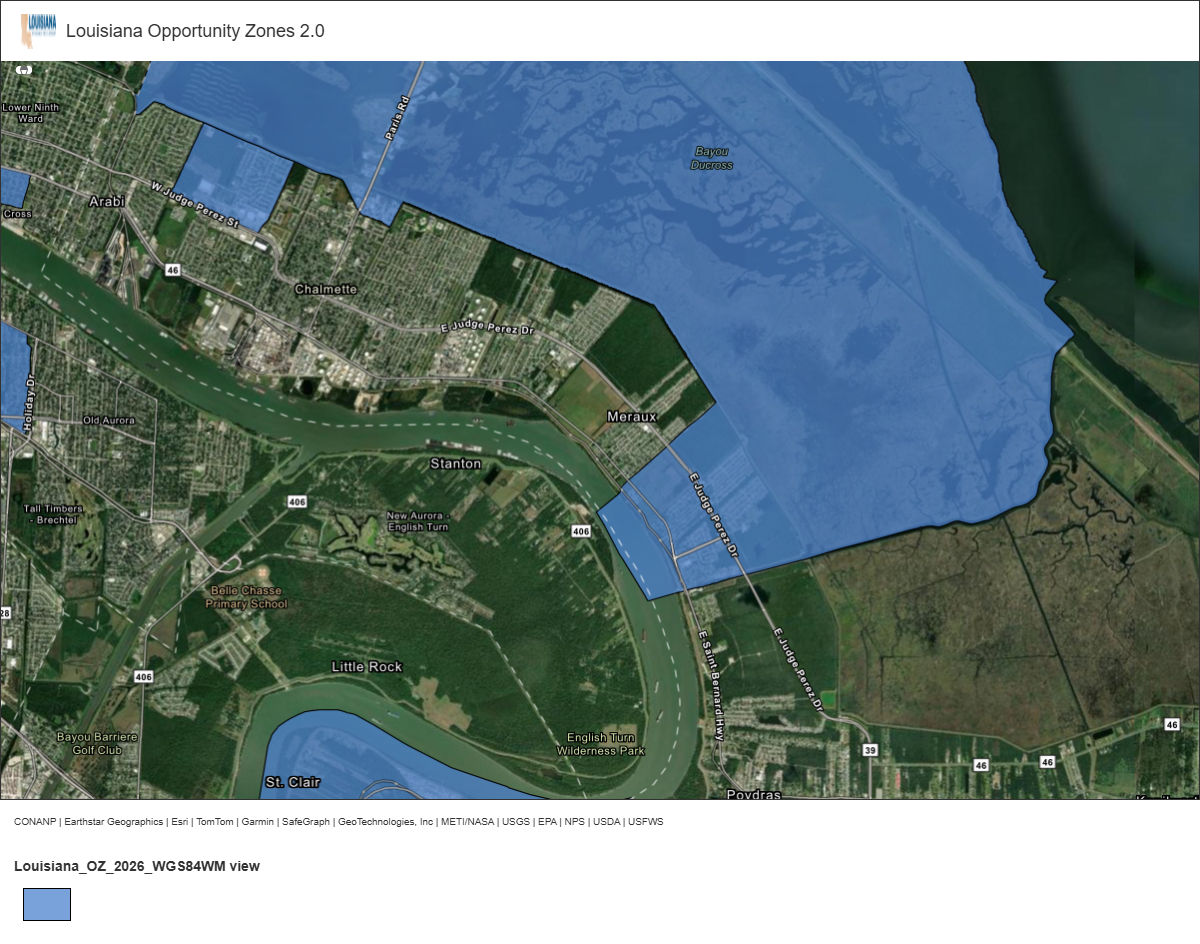
- Arabi / West Chalmette: Census Tract 306.01 (GEOID 22087030601), north of W. Judge Perez Drive between Arabi and Chalmette. This is a mostly residential area of older single-family homes and small multifamily, minutes from New Orleans.
- Eastern Chalmette, Meraux and the river near Violet: Census Tract 302.04 (GEOID 22087030204), a large tract that covers the Paris Road corridor and the wetlands north of town, then runs south along E. Judge Perez Drive through eastern Meraux to the riverfront near Violet. That puts it close to the planned Louisiana International Terminal (LIT) container port in Violet.
Check any specific address on LED’s Opportunity Zones 2.0 map before you buy. Zone lines follow census tracts, not neighborhoods, so one side of a street can qualify and the other can’t.
Why this matters for St. Bernard Parish
Opportunity Zones steer private money toward places that need it, and St. Bernard is entering a growth period.
- The port. The proposed LIT container terminal in Violet is expected to open its first phase around 2028. Port jobs mean demand for workforce housing in Meraux, Violet and Chalmette. I wrote about this in our study, LIT and Residential Property Values.
- Retail and services. Rouses Markets is opening its first St. Bernard store in Chalmette in 2027, a sign that national and regional businesses see momentum here.
- Housing stock. Much of our housing is post-Katrina rebuild or older homes that need work. The OZ rules reward building new or substantially renovating, which is exactly what these neighborhoods need.
For homeowners, a zone designation alone doesn’t change your taxes or your property. For the parish, it means more investor attention, more renovation and more new construction over the next decade.
How investors can use Opportunity Zones: the benefits
For investments made on or after January 1, 2027:
- Defer the tax on your gain for five years. Invest a capital gain into a QOF, generally within 180 days of the sale, and you don’t owe tax on it until five years later (or until you sell the QOF investment, if sooner).
- Pay tax on only 90% of that gain. Hold for five years and you get a 10% step-up in basis on the deferred gain. Rural zones get 30%, but both St. Bernard tracts are designated non-rural, so the standard 10% applies.
- Pay zero federal tax on the new appreciation. Hold the QOF investment for at least 10 years, and the growth in value is tax-free when you sell. You have up to 30 years to claim that.
Example: You sell stock with a $200,000 gain and put that $200,000 into a QOF that builds duplexes in Meraux. In year five you pay tax on $180,000 instead of $200,000. In year 12 the fund sells the duplexes and your share is worth $450,000. The $250,000 of growth is free of federal capital gains tax.
The rules that trip people up
- Only the gain counts. Unlike a 1031 exchange, you don’t have to reinvest your whole sale price. But only the gain portion you invest gets the OZ benefits.
- Existing buildings must be substantially improved. If the fund buys an existing building, it generally has to spend at least as much on improvements as it paid for the building (not counting land) within 30 months. Buy a house for $150,000 where the land is worth $40,000, and you need about $110,000 in renovations. Ground-up construction on vacant land qualifies more easily.
- Plan for the year-five tax bill. The deferred tax comes due in year five whether or not you’ve sold. Keep cash available.
- A buy-and-hold rental left “as is” won’t qualify. The fund has to build new or substantially improve what it buys.
- Old zones run on old rules. Investments made under the first round stay under those rules. LED says benefits for the 2018 tracts sunset December 31, 2028.
Frequently asked questions
When do St. Bernard Parish’s new Opportunity Zones take effect?
January 1, 2027. They stay in place for 10 years.
Which census tracts are St. Bernard Parish’s new Opportunity Zones?
Census Tract 306.01 (Arabi / West Chalmette, GEOID 22087030601) and Census Tract 302.04 (eastern Chalmette, Meraux and the riverfront near Violet, GEOID 22087030204). Both are non-rural.
Do I have to live in the zone to get the tax break?
No. The benefit goes to the investor in the Qualified Opportunity Fund. You can live anywhere.
Can I use money from selling a rental property?
Often, yes. Gains from selling real estate are a common source. Depreciation recapture can be treated differently, so ask your CPA.
Does living in an Opportunity Zone lower my property taxes?
No. The program is a federal capital gains tax incentive for investors. It doesn’t change property taxes or homestead exemptions.
Can I form my own Opportunity Fund?
Yes. Many small investors set up an LLC as their own QOF. It must meet the federal asset tests and file the required IRS forms each year. Work with a tax professional.
Talk to someone local
Finding the right property in the right census tract is half the work. Arpent Realty knows these streets, and our property management team manages hundreds of rental homes across St. Bernard Parish. If you’re an investor or fund looking at Arabi, Chalmette, Meraux or Violet, call us at 504-356-3897. You can also join us at the monthly St Bernard Parish Real Estate Investors meetup, usually the last Wednesday of the month.
This article is general information, not tax, legal or investment advice. Opportunity Zone rules are detailed and still being finalized by the IRS. Talk to a qualified tax professional before investing.
Sources: Louisiana Economic Development, Federal Opportunity Zones · NAHB: Treasury Announces New Opportunity Zone Designations · Scotsman Guide: Treasury designates 6,576 census tracts · Plante Moran: The OBBB and Opportunity Zones 2.0 · Fishman Haygood: Rouses’ first St. Bernard location