
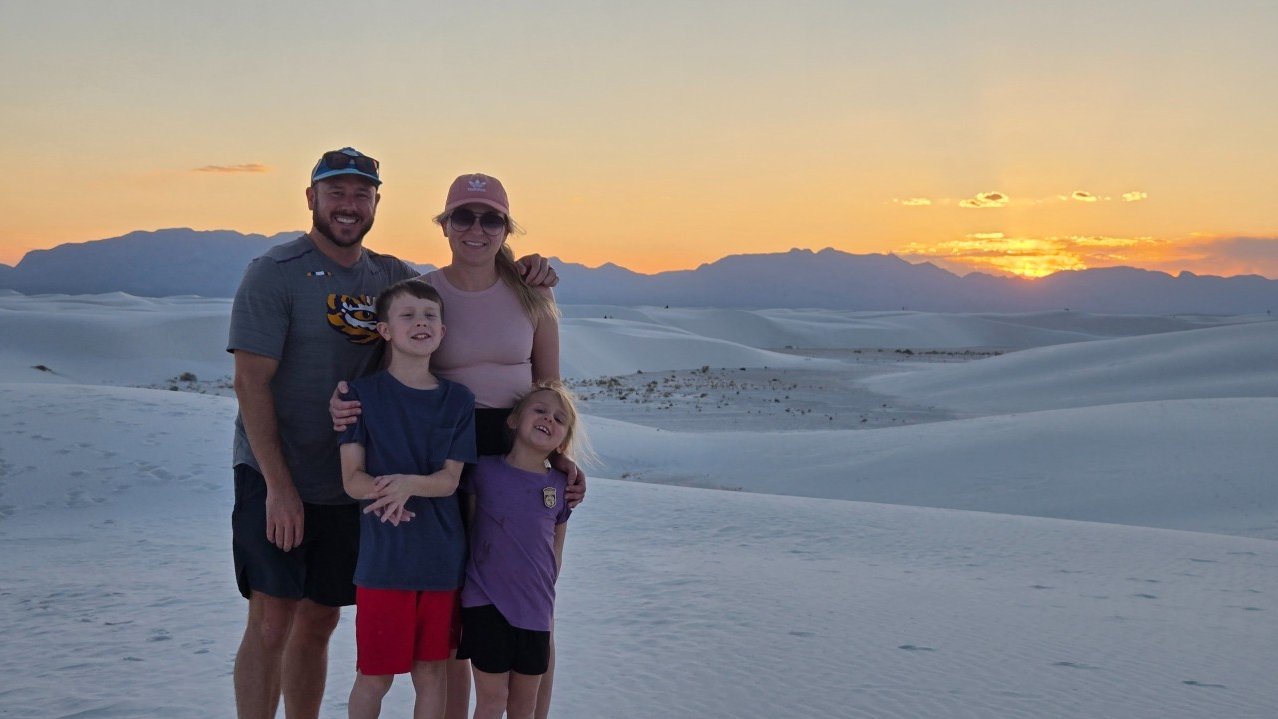
People usually think my wife and I are insane when we tell them we just packed a family of four (plus the dog) into a Toyota Prius for a 2,000-plus-mile road trip to a 30-day stay in the Sierra Nevada mountains of California.
We started this family tradition four years ago, and it’s my absolute favorite thing we do as a family every year. We’ve seen a ton of national parks and explored areas we’d never seen, or even heard of, before. Our kids are seeing climates, cultures and terrain they never imagined.
Before I get to the five reasons you should plan a 30-day trip with your family, I want to address the two objections we hear most: “must be nice…” and “there’s no way we could do that.”
“Must be nice…”
It is. But not in the way you think. When people hear “30-day trip,” they imagine luxury resorts, expensive hotels and a $25,000 price tag. In reality, it’s closer to living in another place for 30 days than a month-long vacation.
We don’t stay in fancy hotels, we don’t eat out every night, and we don’t throw money away on tourist traps. We usually rent a modest one- or two-bedroom cabin or guest house on Airbnb near mountains or national parks. Airbnb discounts for stays longer than 28 days are often up to 50%, and we’ve never spent more than $3,500 for the 30-day booking.
We cook most meals at “home,” go for walks and hikes, visit national parks (free for us since we have a fourth grader), hang out by rivers and creeks, and play board games. Our food budget is no different than if we’d stayed home. We might spend a little more on gas and fun things here and there, but overall we spend far less than a typical family trip to Disney World. So yes, it IS nice, but not because we’re rich or spending $25,000 on a vacation.
“There’s no way we could do that…”
Maybe. But maybe not. I’m sure you have a mountain of reasons you couldn’t leave for 30 days: work won’t allow it, who will water the plants, little league games, and on and on. I know some people really can’t pull this off. If you’re a cop or a firefighter, asking to work from home for a month won’t go well.
But if COVID showed us anything, it’s that most jobs can be done mostly remote. Before you convince yourself your boss would never go for it, read The 4-Hour Workweek by Tim Ferriss. The other reasons, I promise, are figure-out-able, and likely cheaper and easier than you think.
Think of it this way: if someone offered you $1 million to pull this off, could you do it? The question isn’t whether it’s easy. It’s whether it’s possible. Once you know it’s possible, doors start opening.
With that out of the way, here are five reasons this works so well for our family and our business.
1. One decision removes hundreds of others
Peter Drucker has a principle I’ve always loved: look for one decision that eliminates hundreds of other decisions. This trip is exactly that. Deciding to leave for 30 days removes thousands of small decisions and lines us up with our long-term priorities.
My 2026 goals are to get closer to God, be a better husband, be a better dad, get healthier and grow my business, in that order. I want more time reading, exercising, playing outside with the kids and spending quality time with my wife. At home, I’m fighting through hundreds of competing priorities that pull me away from those things. For these 30 days, there are very few distractions.
2. Family time becomes the default
Family time sits above all of our professional, health and business goals. But life has a way of pulling us away from what we value most. As a business owner, there’s no shortage of evening phone calls, late hours, weekend open houses, meetings and closings. Add baseball games, after-school activities, game nights and church events.
All of those are great, but together they create a chaotic schedule that makes meaningful family time hard. It’s easy to tell ourselves we’ll buckle down and start family game night or date night, but life usually gets the best of us. Except on these trips. Family time is the default setting.
3. Freedom is why I got into real estate in the first place
The whole reason I started investing in real estate, and eventually started a business, was future upside and freedom. Entrepreneurship comes with long hours, uncertainty, enormous pressure and the occasional sleepless night. We put up with the lows for the freedom and upside that hopefully come with it.
What’s the point of all that sacrifice if we never cash in on the benefits? Otherwise, you might as well get a high-paying W-2 job without the stress.
4. It forces me to work on my business, not in it
Ask most business owners how they’d feel about leaving their business for 30 days and watch their face turn green. Being gone that long forces me to put systems, processes and, most importantly, people in place. It’s a stress test. It quickly shows where I’m micromanaging and where I’m the bottleneck.
Things break every time. Good. That shows me where I need a better system, a new process or more training for someone on the team. I still work on these trips, usually four or five hours a day, four days a week, but the goal is to lower that every year. If my business can’t function without me there 40-plus hours a week, I haven’t built a business. I’ve built a job.
Eventually, I’d love for every key person in our business, me included, to take a 30-day sabbatical: no calls, no emails. Baby steps.
It also creates growth opportunities for the team
Entrepreneurs have a toxic trait: we think no one can do it as well as we can. We become bottlenecks, and our teams usually just want us out of the way. When I’m gone, team members get to take ownership, solve problems and build new skills. They can’t walk into my office and ask, “Hey Mike, how should I…?”
Things I’d normally hold onto (“it’s faster if I just do it”) become hands-on experience for someone else. Something always breaks or a ball gets dropped while I’m gone. Good. That means we learned the lesson sooner than we otherwise would have.
5. It forces me to say no
I’m a recovering yes man. I’m empathetic by nature, I like helping people, and I don’t like disappointing anyone. That usually leads to me taking on too much and getting out of balance. When I’m 2,000 miles away with spotty cell service, I have a real reason to say no. That blank space, time to go for a walk and think, usually leads to better ideas, new solutions and more clarity on the things I’ve been wrestling with.
Our team in Chalmette keeps things running while I’m gone, and every year they get better at it. If you’re a rental owner who wants that kind of freedom from your own properties, that’s what our property management team is for.
This post first appeared on LinkedIn on June 5, 2026.