
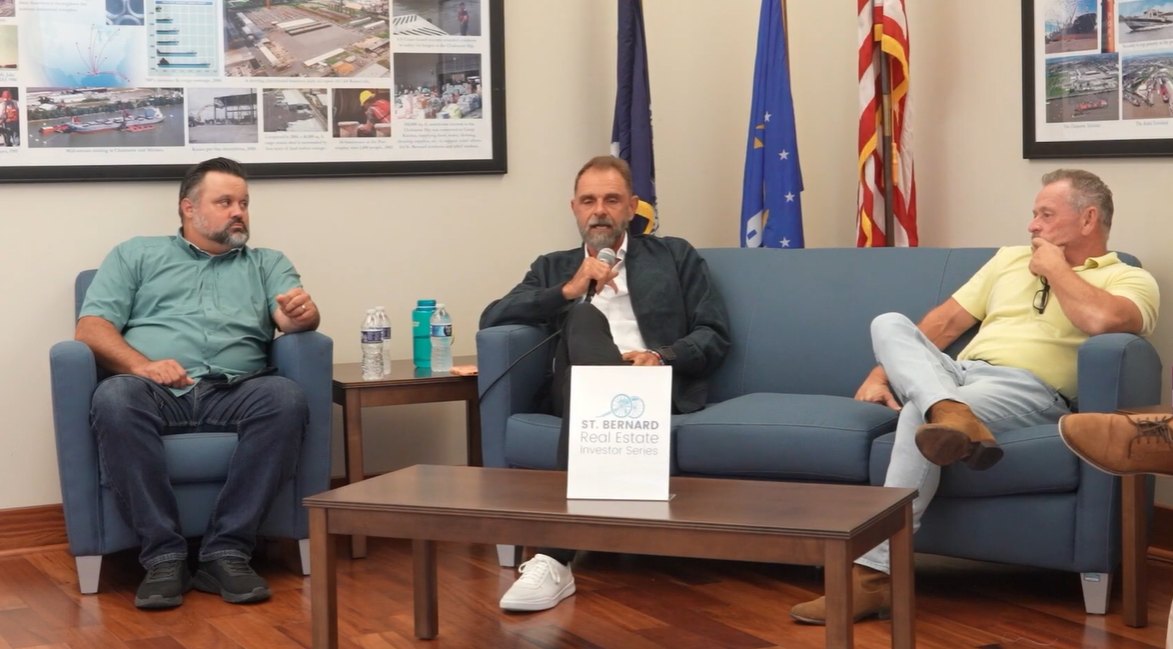
Hurricane Katrina reshaped St. Bernard Parish. In my opening remarks at our August meetup, I shared how the parish went from about 70,000 residents to about 15,000, and congressional records described all of its roughly 25,000 housing units as destroyed or severely damaged.
For many people reading this, those aren’t statistics. They’re your home, your neighborhood and your family’s story.
This panel looked at that period through one lens: what it was like to rebuild, and what investors learned along the way. My guests were builder and investor Machi Medrzycki; my partner at Arpent, Christian Sullivan; and Andy Hunt of Performance Mortgage.
How they got here
None of the three started out in St. Bernard.
Christian was running an appraisal management company in Southern California. He came down soon after the storm and started buying and renovating homes. Machi was in Florida doing storm repairs after Hurricane Charley, and arrived in St. Bernard in 2006 to help an investor group whose projects needed work finished. Andy was a college student working construction with his dad, and came to the parish through a flipping opportunity.
None of them left the same way they came. Andy said it was the people who made his family fall in love with the parish. His kids were born and raised here.
What the market looked like
The panelists remembered houses listed with spray paint or cardboard signs for around $13,000 to $25,000. Those numbers can be hard to hear if one of those homes was yours, and they don’t capture what families were going through.
Rebuilding was hard in ways that are easy to forget. Food and fuel were limited, inspections and basic services were hard to come by, and theft was a real problem. Christian compared it to the Wild West. People were stripping copper out of houses as soon as it was installed, so he stayed on site overnight until the drywall went up.
Andy said his family did most of the work themselves because they didn’t want people to go through Katrina twice by hiring a bad contractor. Machi saw the same problem. Suddenly everyone claimed to be a contractor, and many homeowners lost trust.
How do you price a house with no comps?
This was the question I most wanted to ask. Each panelist had a different answer.
Christian used his appraisal background to reconstruct what neighborhoods looked like before the storm, then bought near areas that had been the strongest. Machi leaned on experienced local agents and bet that middle-class neighborhoods would come back first. Andy worked backward from what an appraiser and lender would need for a buyer to get a loan.
Nobody had a perfect answer. Machi admitted some early value estimates were wrong, and Christian pointed out that the national mortgage crisis also slowed the recovery. Having construction income helped Machi and Andy ride it out.
Five lessons that still apply
1. Buy more doors. Christian said his biggest mistake was focusing on single-family homes. Looking back, he wishes he had bought more doubles and held them.
2. Don’t over-leverage. Machi’s advice was clear: it’s okay to go slower. One expensive turnover or repair can wipe out your cash flow.
3. Know how the money works. Andy said financing knowledge gives you an edge in any market, especially when buyers need help getting approved.
4. Think long term. Andy’s father kept buying parish lots at low prices, and it paid off. Machi used that lesson later in Gentilly, buying lots for new construction before prices climbed.
5. Build a good team. Christian told newer investors to find an honest agent, a strong lender, a reliable contractor and a partner who fills in their gaps.
What’s different now
The parish is much better protected than it was in 2005. Andy called the surge barrier the Great Wall of China, and he believes St. Bernard is here to stay. No place is free from storm risk, but this isn’t the same parish that Katrina hit.
Panelists also agreed something else hasn’t changed: the people. That’s what brought families home, and it’s what keeps investors here today.
Thinking about buying, selling or investing in St. Bernard? Call Arpent Realty at 504-356-3897.
Common questions
How did investors value homes in St. Bernard after Katrina?
Panelists used pre-storm neighborhood data, local agents and lender requirements because recent comparable sales were limited.
What was the biggest missed opportunity for investors after Katrina?
Christian said multi-unit properties. Machi pointed to wholesaling and long-term commercial property.
What’s the top lesson for new real estate investors today?
Machi’s advice was to avoid over-leveraging, take your time and learn from one property before you scale.
Thank you to the St. Bernard Economic Development Foundation for partnering with us. Join the St Bernard Parish Real Estate Investors Facebook group for upcoming events, and watch past meetups on YouTube. Also read our recap of the St. Bernard leadership panel.
This recap is for general information and is not investment advice.